
Technological advances in aviation during World War I led to some civilian applications that included air mail, barnstorming, parachute jumping and stunt flying. Profitable passenger transportation was still in the future, but Minnesotans like Charles Willis Holman and Charles Augustus Lindbergh led the way. Lindbergh made the famous solo flight from New York to Paris. Holman pioneered mail and occasional passenger service for what would become Northwest Airlines. The Curtis “Jenny” figures in the story of both airmen.
Glenn Curtis began manufacturing his “JN Series” airplanes in 1915. JN 1, 2 and 3 were not that successful, but four was the lucky number. 6800 JN-4s were built. They were used by several militaries to train pilots and were sold as surplus after World War I.
Both Holman and Lindbergh started fly- ing in a Jenny. “Speed” Holman acquired his nickname racing motorcycles that he built or modified himself. Holman jumped into avia- tion using a parachute while pestering his wealthy father for flying lessons. The elder Holman agreed to buy his son a Jenny if Speed promised to stop jumping out of perfectly good airplanes. Holman traded his mechanical skills for fly- ing lessons and by 1926 he was doing more sensible things like 1,433 consecutive loops in five hours. Lindbergh was also mechanically inclined and owned a motorcycle. When he was 16, he coaxed his family’s Saxon Six Automobile from Little Falls to California. Lindbergh was taught to fly in Nebraska by Otto Timm, another aviator from Minnesota. The Nebraska school required a bond to solo that Lindbergh couldn’t afford so he left to go barnstorming as a parachutist and wing walker then used what he saved to buy a Jenny. Charles Lindberg flew alone for the first time in his own airplane. Later he took it to Glencoe to aid his father’s political campaign by dropping leaflets on the town. Besides being the first to fly solo across the Atlantic, Lindbergh pio- neered the use of aircraft in politics.
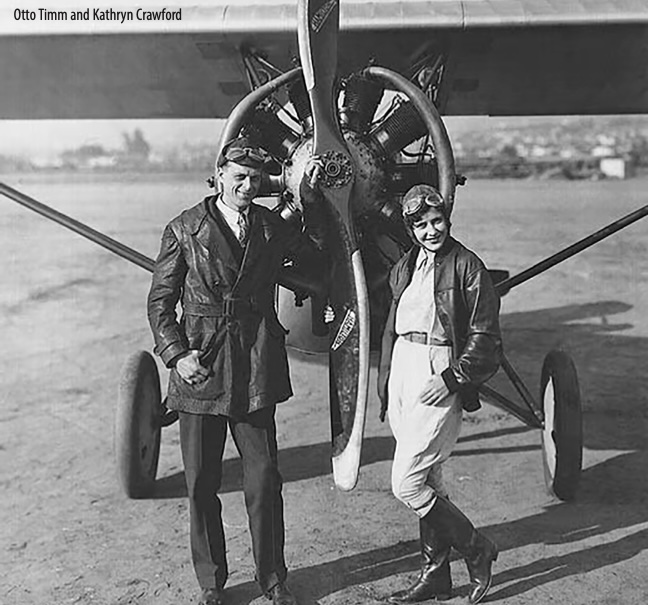
Otto Timm grew up in Lakefield and Windom. Most of his aviation career was spent in California building airplanes, but he was a pilot and just hap- pened to be in Lincoln, Nebraska when young Charles Lindbergh showed up there for flying lessons in 1922.
Timm also did some movie work with singer Kathryn Crawford. Nona Leshia Malloy started as a wing walker and parachutist like Holman. Ms. Malloy was born in Breckenridge but grew up in Oregon. Nona was a rebellious teenager who ran away from home and returned to Minnesota in 1924. She learned to fly in St. Paul. Malloy jumped from airplanes and walked on wings on her way to being a stunt pilot. She went back to Oregon and started a successful business making and packing parachutes that morphed into the “Nona School of Dress Design.”
Possibly a reasonable segue from parachutes but without the excite- ment. Early in the decade, a bankrupt track used for auto racing was taken over by some aviation enthusiasts. By 1923 two runways were established and the place was named “Wold- Chamberlian Field” after two Minnesota pilots who died in World War I. The Minneapolis Park Board took over in 1928. What parks and airports have in common is a mystery, but passenger service started the next year. A few years later and a few miles down the Mississippi, St. Paul established a competing facility that would be named after Charles Holman.
Northwest Airways established their main base there in 1927. Hector is a little town out on the Minnesota Prairie that beat the big cities to public airport ownership in 1925. Hector Municipal Airport has experienced a century of prosperity. The city claims to have the more pilot’s per capita than any other place in the United States.
It’s named for the Prince of Troy from Homer’s Iliad who defended his hometown against the Greeks. It all start- ed with the beautiful Helen who was married to Melenaus, King of Sparta. Helen ran off with her lover, Hector’s brother Paris, starting a long siege that ended with the Greeks sneaking into Troy in a big wooden horse.
For more details, the Minnesota Historical Society has an excellent collection of materials about flying in the 1920s including more about Nona Malloy, Otto Timm, and other aviation pioneers from Minnesota. Read the Iliad to learn about the siege of Troy; it’s only 15,693 lines of poetry.
Technological advances in aviation during World War I led to some civilian applications that included air mail, barnstorming, parachute jumping and