
In 1941 the U.S. Army decided to use gliders to transport airborne soldiers. Aircraft for that purpose were being developed, but the Army had no idea how to train the pilots. During the 1930s soaring or flying sail planes became a growing sport. Tapping civilian sailplane pilots as instructors seemed reasonable but it wasn't. The goal of sailplane pilots is to maximize time aloft, while the Army glider pilots would want to be on the ground ASAP.
Simply doing "dead stick" landings in light airplanes was tried and that morphed into buying those airplanes without motors allowing the students to also gain experience with being towed aloft. The Aeronca Champ became the TG-5 with the cockpit moving forward for balance. Taylor Craft did something similar with the DCO-65 to get the TG-6 that had three seats thus doubling the instruction capacity.
As many as 5500 glider pilots were trained. Most of them flew combat missions, some learned their skills at the Flynn Farm in Baytown, Minnesota which had been commandeered for that purpose.
Near the end of the war, the Metropolitan Airports Commission was formed, and MAC selected a site just west of the glider field for a new airport. It was still in Baytown, but the Village of Lake Elmo was just down the road. It opened in 1951.
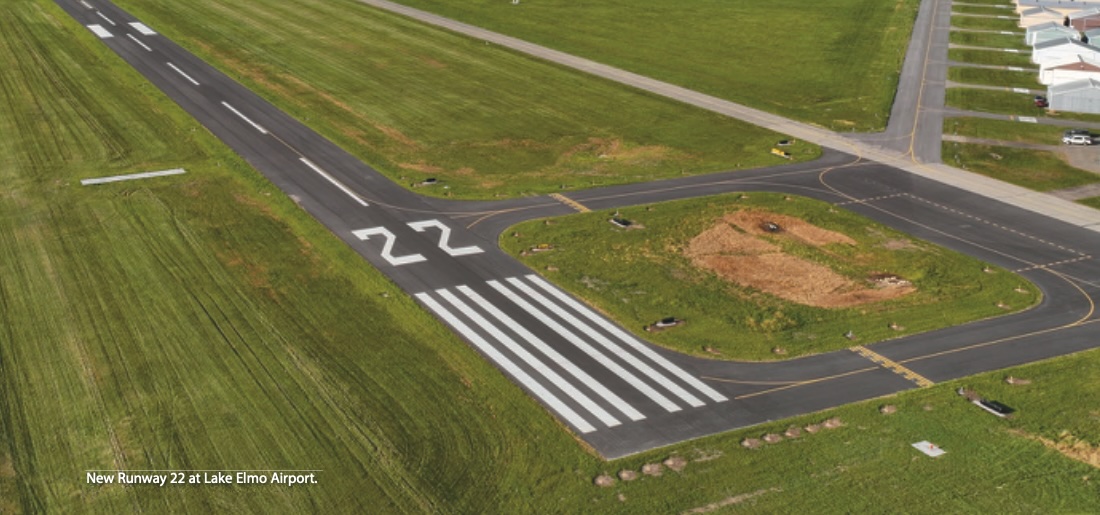
Twenty-five years later Lake Elmo Airport had a northwest/southeast runway, paved, with lights and 2800 feet long; and a southwest/northeast runway with 2500 feet of pavement but unlit. The building area was on the southwest side of the airport. The only instrument approach was a non-directional beacon (NDB) procedure to the unlit runway meaning night approaches required "circle to land" in the dark with low ceilings and/or poor visibility. A plan completed in 1980
6 November 2026 Minnesota Flyer